Platform
Meridian
An SEO intelligence platform that replaces sprawling spreadsheets with unified, URL-level analytics — pulling data from Google Search Console, GA4, Ahrefs, and AI search engines into a single actionable view.
Role
Creator & Developer
Timeline
2025 – Present
Team
Solo project
The challenge
Managing SEO at scale means juggling data across Google Search Console, GA4, Ahrefs, Semrush, and AI search analytics. The typical workflow involves exporting CSVs into a thousand-plus-row spreadsheet, manually cross-referencing URLs, and hoping nothing gets missed. It's slow, error-prone, and impossible to keep current.
The approach
Meridian aggregates all SEO data sources into a single PostgreSQL database with a unified URL-level schema. It provides instant filtering, sorting, and visualization. API integrations pull fresh data automatically, eliminating manual exports and giving the team a single source of truth that's always current.
Process
Five phases from audit to launch.
Deep Dive
Building Meridian
For years, the SEO teams I’ve worked on and managed have had to rely on bulky, thousand-plus row spreadsheets for keeping track of keywords, their associated URLs, and the analytics along with them. These complex sheets relied on importing crawl results, linking tools like SuperMetrics for analytics, and manually assigning taxonomy values to thousands of URLs.
The load time of the sheet alone was enough reason to move. But the manual work makes a sheet like that a snapshot in time, not a true data source. And the disparate data sources make multi-touch decisions impossible. That’s the problem that necessitated Meridian.
Dashboard
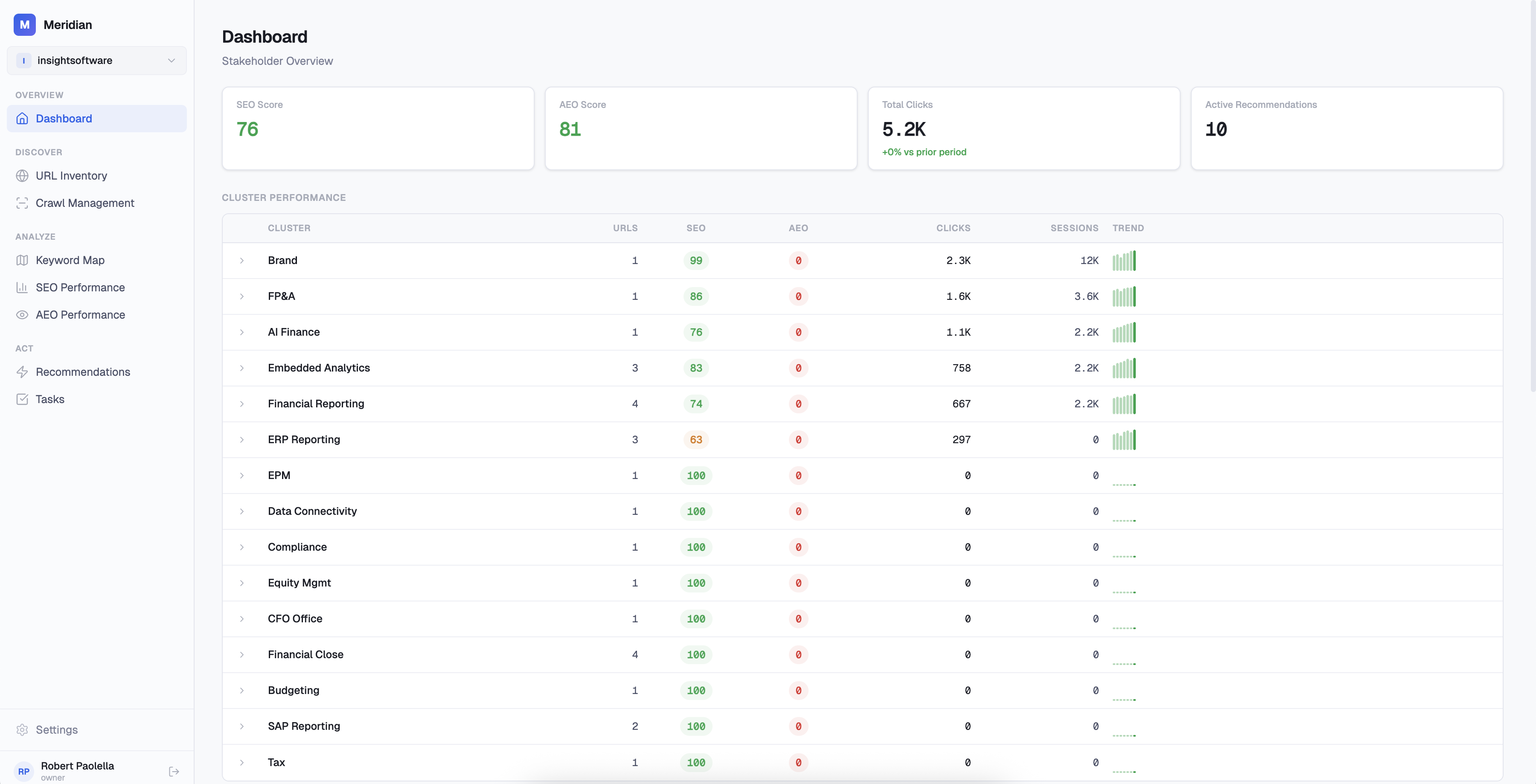
The dashboard provides a clean, high-level overview of SEO and AEO performance, all in one location. The data is filtered by cluster for a top-down view of the most important keyword groups. A taxonomy rollup outlines performance by key categories such as product, buying phase, persona, or any user-defined taxonomy. A recent wins view shows what’s working in an executive-friendly format.
Keyword Map
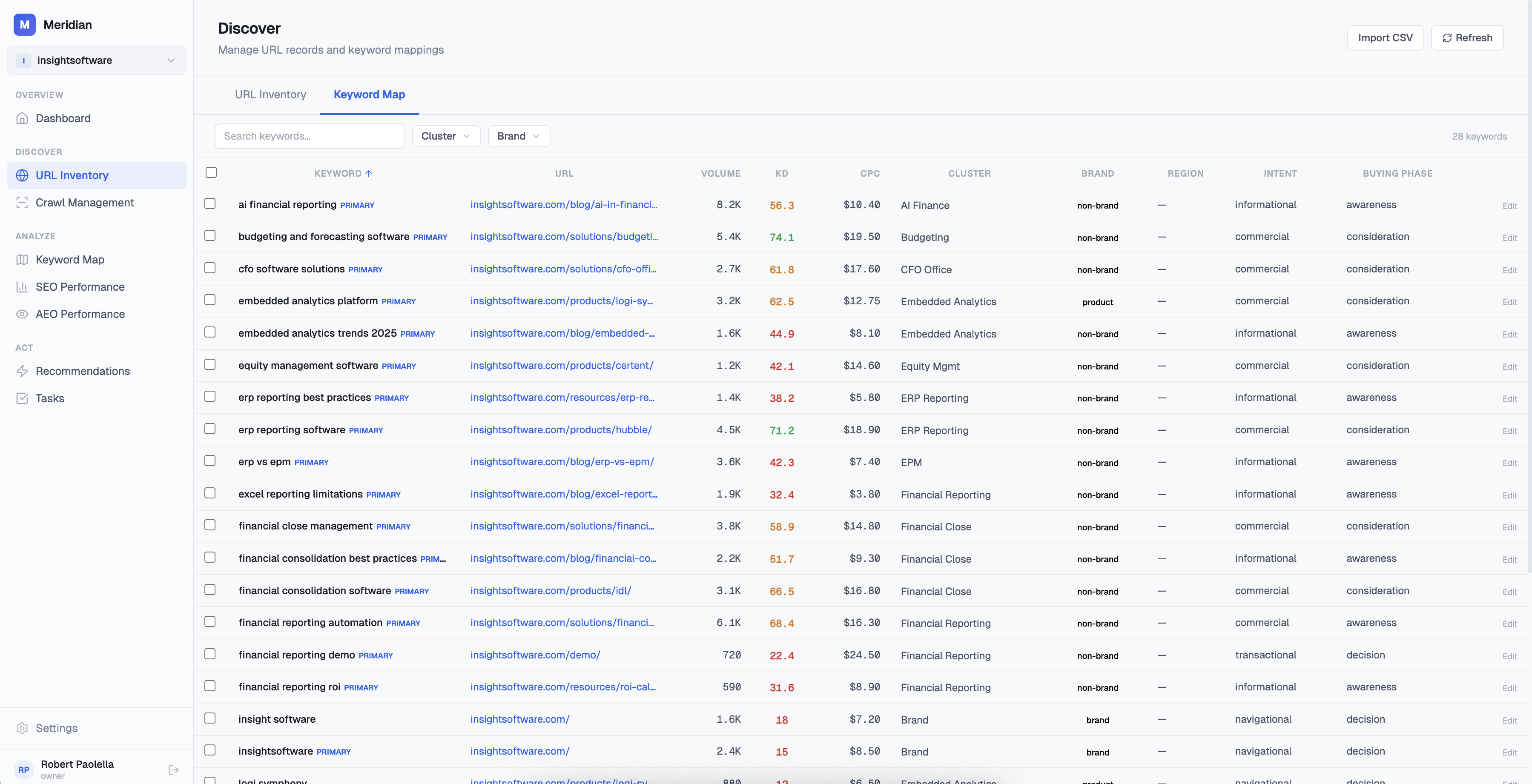
This is where all the magic lives. With URLs as the schema that normalizes all other data, everything from target keyword to PPC trends are consolidated into a single view. The maps helps outline everything that’s happening around a single URL and keyword pair. This is the command center where SEOs can decide what’s working and what is in need of improvements.
SEO Overview
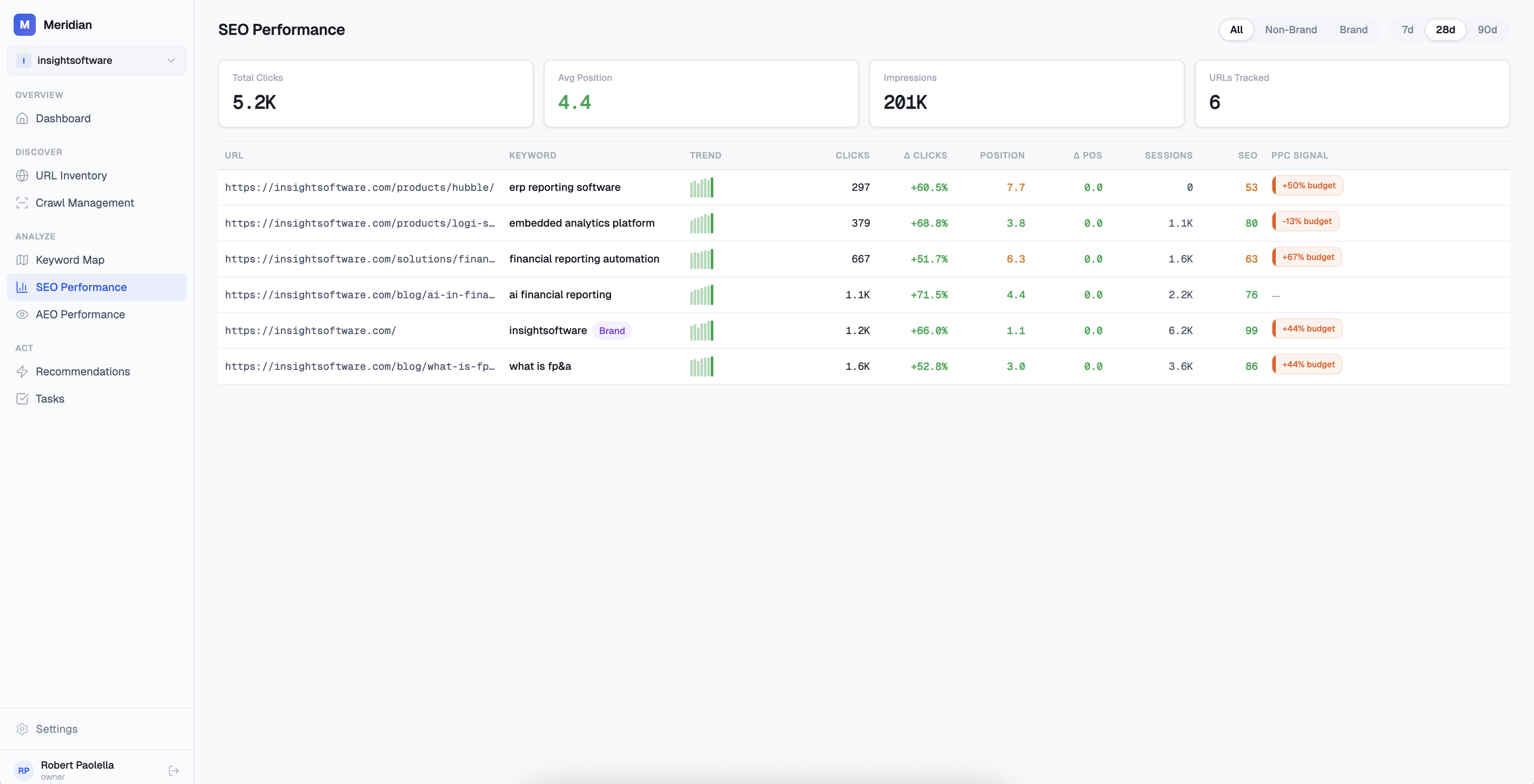
SEO Performance is the pulse check. It surfaces the metrics that matter most — clicks, impressions, average position, and position delta — across every tracked URL and keyword pair. Trend sparklines give an at-a-glance read on momentum without needing to dig into charts. A PPC signal column bridges the gap between organic and paid, flagging where budget is shifting so SEOs and paid media managers aren’t working in silos. Filters for brand vs. non-brand and flexible date ranges (7d, 28d, 90d) let users toggle between tactical and strategic views in one click. It’s the page you open first thing in the morning to know where you stand.
Recommendations
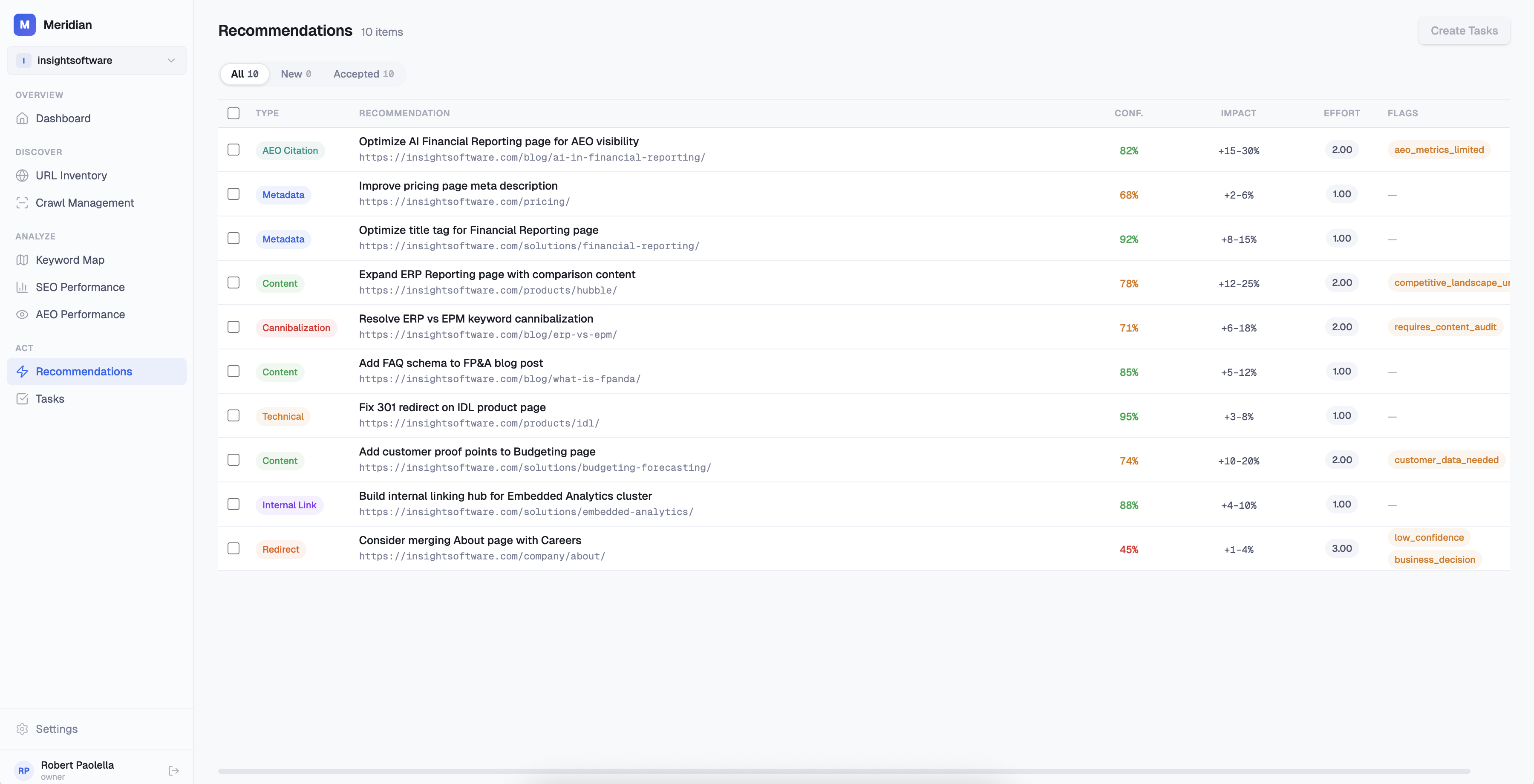
With an LLM integration, Meridian is able to provide AI insights and recommendations for optimizing content. It can provide recommendations for content changes, technical and metadata changes, cannibalization risk assessment, and internal linking opportunities. It even gives recommendations on AEO citations. With a built-in kanban style task system, all of the actions an SEO performs live right in the platform.
Outcomes
3,000+
URLs tracked
4
Data sources unified
Real-time
Data freshness
1
Single source of truth
Tools & Disciplines